Uwazi for research and OSINT I
A case is a hub of documents
Uwazi’s Library turned into a research and OSINT tool.
Juan M. Cornejo
Uwazi for research and OSINT I
A notebook
This notebook covers two parts of the Uwazi research tools on CEJIL’s public database: how a case holds its documents, and what connects two cases.
- Notes2
- A case, sketched3
- A case is a hub of documents4
- One case, its links5
- How a case holds its documents6
- A case in the prototype7
- Its links, grouped8
- What connects two cases9
- Three pairs of cases, measured10
- Try it11
- Two routes between two cases12
- Connect to, in the prototype13
- The path, drawn14
- Where the numbers come from15
- In short16
1Uwazi for research and OSINT I
Notes
- SUMMA is CEJIL’s public Uwazi database of the cases heard by the Inter-American Commission and Court of Human Rights.
- Both bodies decide the same cases. Before SUMMA, their decisions were kept in two separate databases.
- In Uwazi, a record’s template sets its fields. A relationship is a typed link between two records.
- In SUMMA the case is the core record: every document of a procedure links to its case.
- A case can inherit a value from a record it links to, such as a place’s coordinates.
- A path is a chain of links from one record to another, and a hop is one link in it.
- A hub is a record linked to hundreds of others, such as the Court or a country.
- I designed “Connect to…” in a research prototype for Huridocs. It lists the shortest paths between two records.
2Notes
A case, sketched
Figure 1. A case, sketched in code. The documents of a procedure link to one case record, and the case takes its coordinates from its place.
3Uwazi for research and OSINT I
Chapter 1
A case is a hub of documents
SUMMA keeps the Court’s and the Commission’s documents in one database. Each procedure has a case record, and every document of that procedure links to it.
The case lists its documents in relationship properties, fields whose values are links: Documentos de la CorteIDH for the Court’s, Documentos de la CIDH for the Commission’s. The relationship type names the kind of link. The property says which list on the case it fills.
A case also links to a place and inherits its coordinates. It appears on the map without storing a coordinate.
The next page counts one case’s links. The page after it draws the model.
4A case is a hub of documents
One case, its links
| Relationship type | Links to | Links |
|---|---|---|
| Masacres de El Mozote | ||
| CorteIDH | Court documents: 7 resolutions, 3 presidency resolutions, 2 judgments, 2 hearings | 14 |
| CIDH | Commission documents: an admissibility report, a note sending the case to the Court, a merits report | 3 |
| País | its country, El Salvador | 1 |
| Geolocalización de los hechos del caso | its place, whose coordinates (13.902, −88.113) the case inherits | 1 |
| Medidas de Protección | a provisional measure | 1 |
| In all | 20 | |
The case record lists 16 Court documents. Two of them are not in the copy, so the copy counts 14 Court links and 20 links in all. No case in the copy lists more Court documents than 16; one other case lists as many.
The collection around it, live on 22 October 2026: 5,354 records, 19 templates, 17 relationship types and 423 cases. In the copy: 4,398 records in each of three languages, 18 templates, 337 cases and 16,998 links, 5,054 of them with no type.
Table 1. Masacres de El Mozote’s links in the research prototype’s public copy of SUMMA (1 July 2026), by relationship type. Live counts from SUMMA’s public API (summa.cejil.org/api); the copy’s from its public files, entities.json and relationships.json.
5Uwazi for research and OSINT I
How a case holds its documents
Figure 2. El Mozote in the copy. Its documents link to the case, and the case takes its place’s coordinates from the sheet below.
- 1Each document is its own record, with its own template.
- 2The case lists the documents in two fields, one for each body.
- 3The place is a record too. The case shows its coordinates by inheritance.
6How a case holds its documents
A case in the prototype
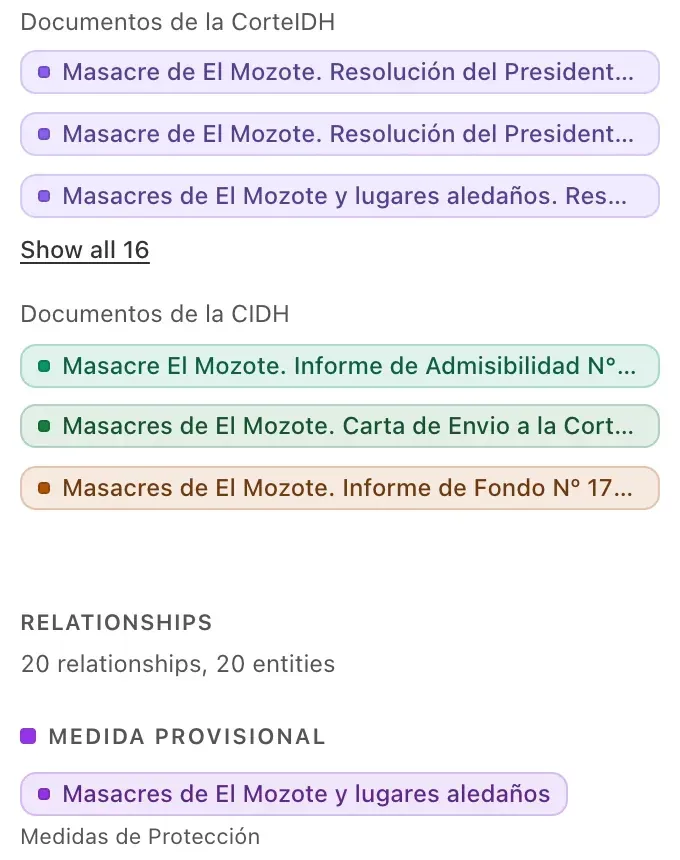
- 1Documentos de la CorteIDH: a relationship property
- 2Three shown; 16 listed
- 3Documentos de la CIDH, a second property
- 4Each document’s colour is its template
- 5Twenty links in all
- 6A provisional measure, linked by Medidas de Protección
Plate 1. The key facts of the case Masacres de El Mozote. The Court’s and the Commission’s documents are fields of the case, each a list of links to other records. The research prototype on its copy of SUMMA, CEJIL’s database (huridocs.github.io/uwazi-design/playground).
7Uwazi for research and OSINT I
Its links, grouped
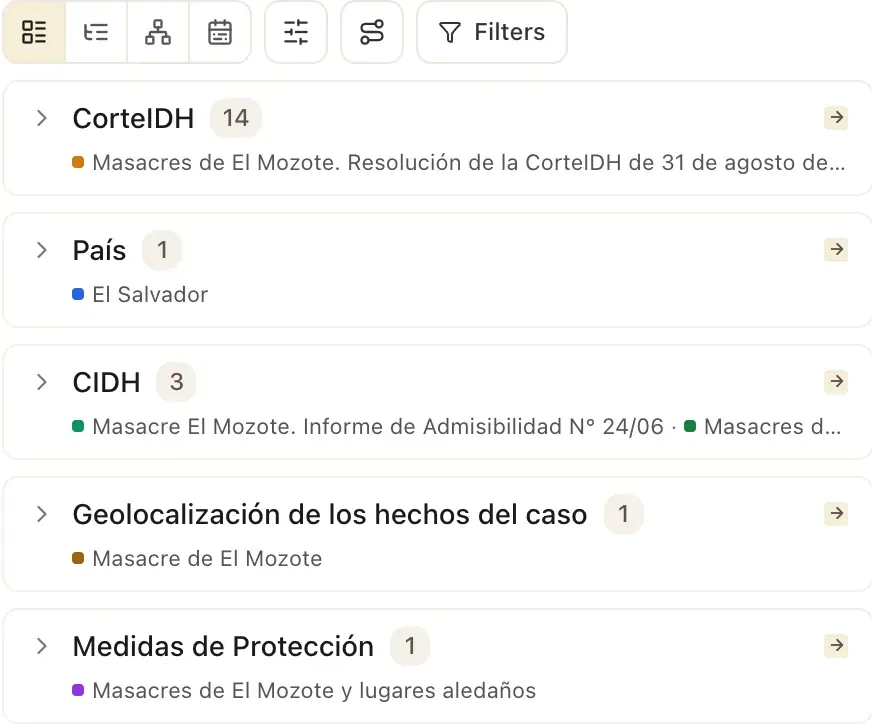
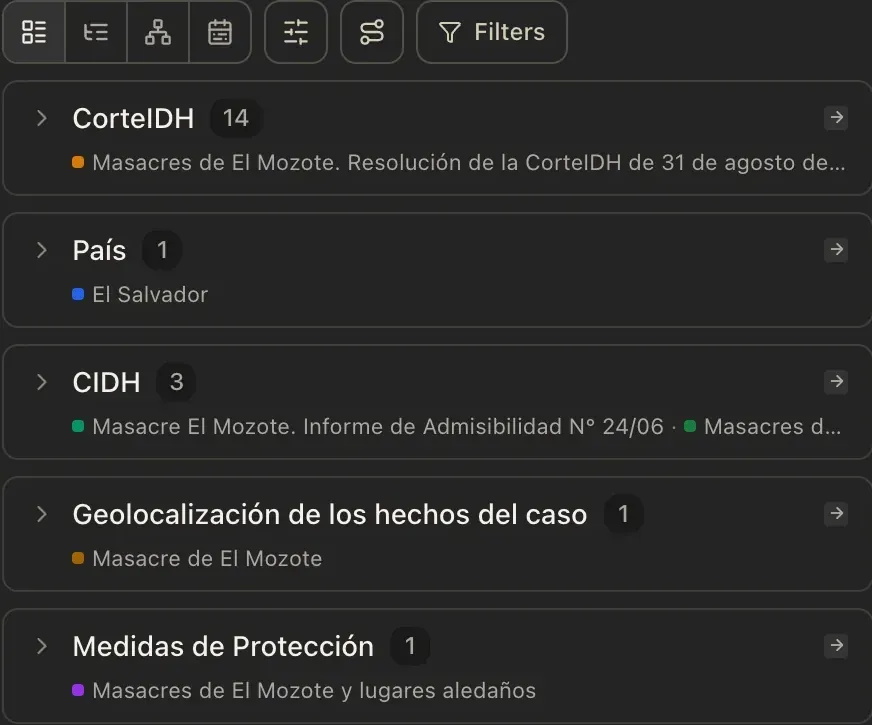
- 1The same links as a list, a tree, a graph or by date
- 2Grouped by relationship type: 14 Court documents
- 3Its country
- 4Three Commission documents
- 5Its place, one link
- 6A provisional measure
Plate 2. The same case’s Relationships tab, its 20 links grouped by relationship type, each group with its count and its first records. The research prototype on its copy of SUMMA, CEJIL’s database (huridocs.github.io/uwazi-design/playground).
8Its links, grouped
Chapter 2
What connects two cases
“Connect to…” lists the shortest paths between two records, up to four hops, and names the relationship type of each hop.
In SUMMA most paths run through a few records. In the copy the Court is linked to 2,739 records and one country to 711. A path through the Court says only that both cases reached the Court.
The prototype skips such records by default in two of its collections: in a Nepal collection it skips sources and places, and in a collection of a real event’s public recordings, sources. For SUMMA it skips nothing. These pages apply the same rule to countries and organs and compare the paths.
Counts disagree for a similar reason. The busiest judge or commissioner in the copy has 440 links to 417 records: one view counts links, another counts records. In the old Relationships panel, my audit found one person read 349 on the tab, 327 in the graph and 326 on the profile.
9Uwazi for research and OSINT I
Three pairs of cases, measured
| Cases | Countries, organs | Hops | Paths | Paths through |
|---|---|---|---|---|
| El Mozote to Caracazo | allowed | 4 | 153 | 135: the Court |
| skipped | 4 | 13 | all 13: one of 3 judges or commissioners | |
| El Mozote to El Amparo | allowed | 4 | 192 | 165: the Court |
| skipped | 4 | 22 | all 22: one of 4 judges or commissioners | |
| Caracazo to El Amparo | allowed | 2 | 1 | Venezuela |
| skipped | 4 | 8 | all 8: one of 5 judges or commissioners |
From El Mozote to Caracazo there are 153 shortest paths of four hops, and 135 of them pass the Court. Skip countries and organs and four hops still suffice: 13 paths remain, through two Court documents and a judge or commissioner linked to both.
Caracazo and El Amparo are both Venezuelan cases, so with countries allowed they are two hops apart, through Venezuela. Without countries they are four hops apart, like the others.
Table 2. Shortest paths of up to four hops between three place-named cases in the research prototype’s public copy of SUMMA (1 July 2026), measured when the page was built with the prototype’s search rewritten for this page. A path counts once per sequence of records.
10Three pairs of cases, measured
Try it
Figure 3. The shortest paths between two cases in the research prototype’s public copy of SUMMA (1 July 2026), found by the prototype’s search rewritten for this page. Pick two cases, skip countries and organs, and point at a record to see the paths through it.
11Uwazi for research and OSINT I
Two routes between two cases
Figure 4. El Mozote to Caracazo in the copy. Both routes are four hops long. The high one passes records that many others link to; the low one passes a judge or commissioner linked to documents of both cases.
- 1A block’s height stands for its links: the Court 2,739, Venezuela 385.
- 2With every record allowed, 135 of the 153 shortest paths pass the Court.
- 3With countries and organs skipped, 13 remain, each through a judge or commissioner.
12Two routes between two cases
Connect to, in the prototype
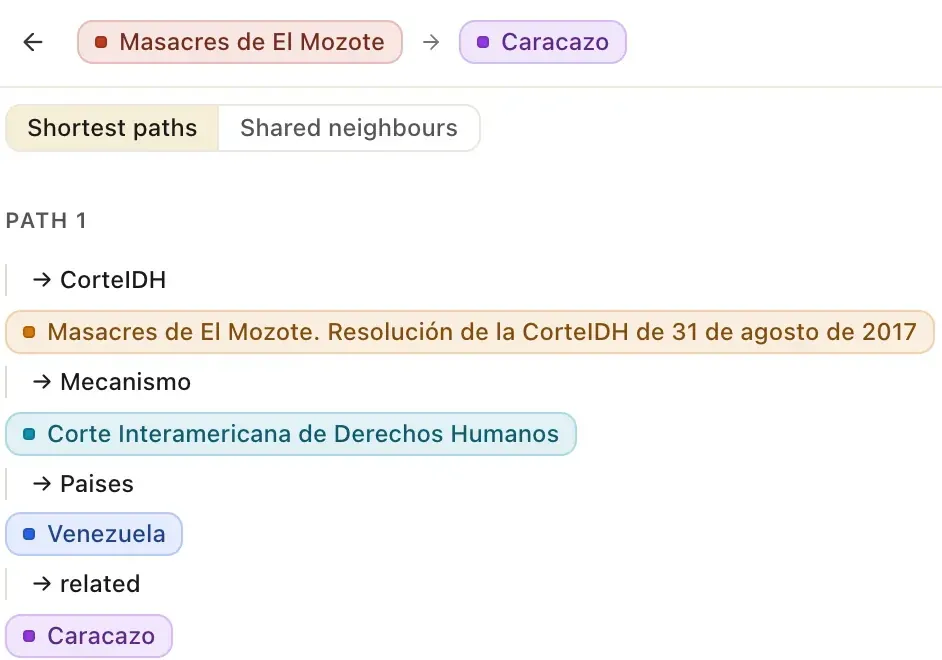
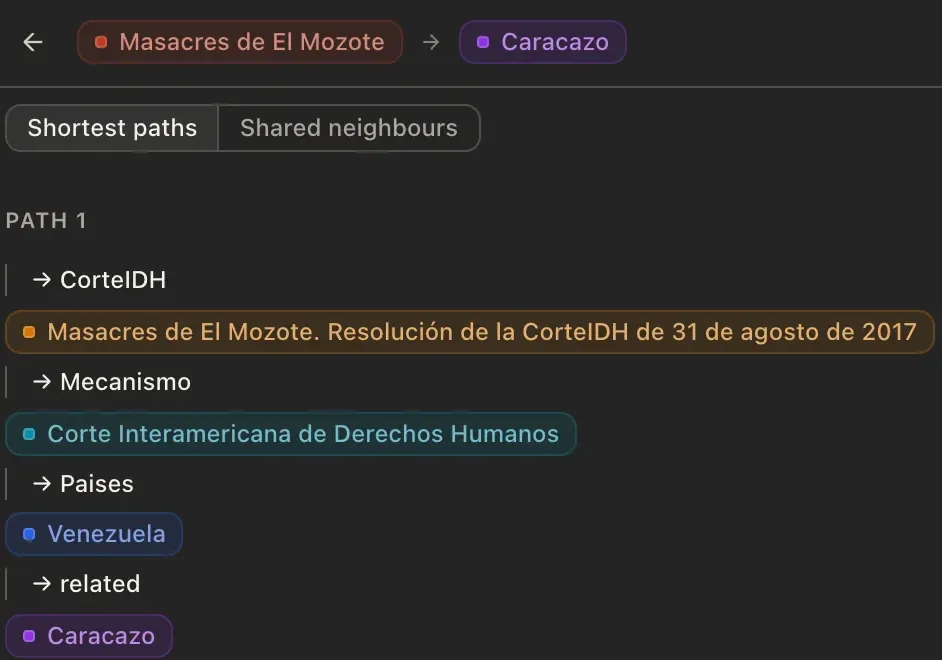
- 1The two ends: El Mozote and Caracazo
- 2Shortest paths, or the records both share
- 3Each hop names its relationship type
- 4The Court: 2,739 links in the copy
- 5A country, Venezuela
Plate 3. “Connect to…” from El Mozote to Caracazo. The first path runs through a Court resolution, the Court and Venezuela. The dialog lists the first 20 shortest paths, all of four hops. The research prototype on its copy of SUMMA, CEJIL’s database (huridocs.github.io/uwazi-design/playground).
13Uwazi for research and OSINT I
The path, drawn
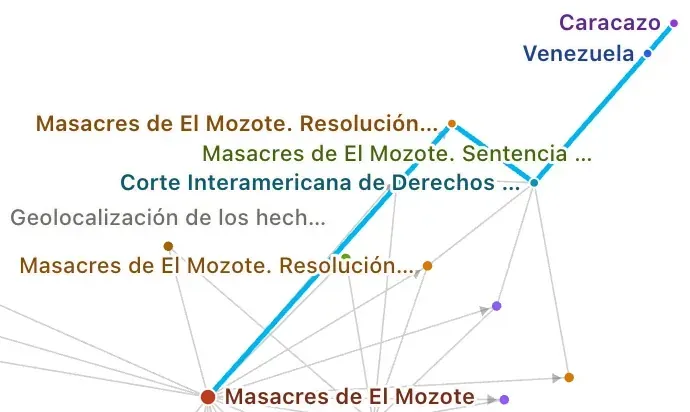
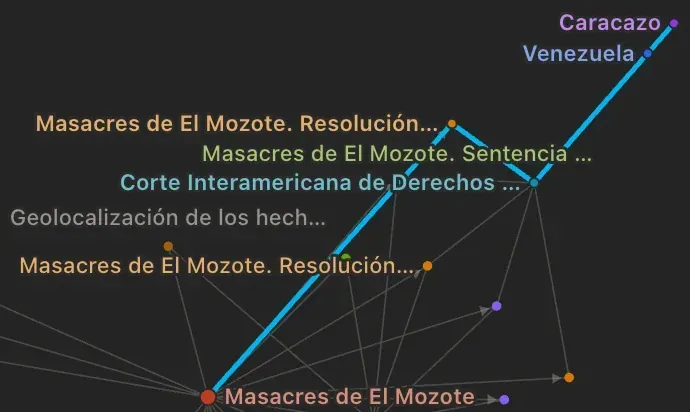
- 1El Mozote, with its own links
- 2A Court resolution, the first hop
- 3The Court
- 4Venezuela
- 5Caracazo
- 6The path, over the case’s own links
Plate 4. The same path drawn in the case’s graph: four hops, and three of them through records that many others link to. The research prototype on its copy of SUMMA, CEJIL’s database (huridocs.github.io/uwazi-design/playground).
14The path, drawn
Where the numbers come from
| Figure | Live | Copy |
|---|---|---|
| Records (Spanish) | 5,354 | 4,398 |
| Templates | 19 | 18 |
| Relationship types | 17 | 12 named |
| Cases | 423 | 337 |
| Court judgments | 506 | 409 |
| Judges and commissioners | 143 | 137 |
| Links | 16,998 | |
| Links with no type | 5,054 | |
| The Court’s links | 2,739 | |
| Court documents of a case | median 6, most 16 |
Table 3. Live: SUMMA’s public read API, summa.cejil.org/api (search, templates, relationtypes), read on 22 October 2026. Copy: the prototype’s public files of 1 July 2026, at huridocs.github.io/uwazi-design/playground/cejil-data, counted for this page. The copy holds each record in Spanish, English and Portuguese.
The model is described in HURIDOCS’s case study “SUMMA-CEJIL database” (doc-resources.uwazi.io), pages 3 to 10. The two separate databases are from HURIDOCS’s post of December 2017. The count of 349, 327 and 326 is from my own audit of the old panel, not a public page.
15Uwazi for research and OSINT I
In short
In SUMMA a case is the record its documents link to, and the links carry their type. That makes two cases easy to connect and hard to connect well: most paths pass the Court or a country, so a useful path search has to be told what to skip.
The prototype’s relationship tools were made for Huridocs and not shipped. Its copy of SUMMA is public. The next notebook covers who says so.
another notebook Uwazi for research and OSINT II
16In short