Railcar Management
The plan, alive
A petrochemical rail yard ran on paper.
Juan M. Cornejo
Railcar Management
A notebook
Railcar Management turned the day’s printed plan into a board that changes as the yard moves. The board shown here is a model, built from invented data.
- Notes2
- The board, sketched3
- The plan, alive4
- The day, on paper5
- Try it6
- The plan on a display7
- The plan in a hand8
- The yard and the plan9
- In short10
A petrochemical rail yard ran on paper. I stood in it across shifts, then designed the two apps that replaced the printout: one for gloved hands in the weather, one for the people scheduling them inside.
1Railcar Management
Notes
- A railcar arrives full of petrochemical waste. It is parked on a track, matched to a machine and a silo, emptied, cleaned and sent back out.
- The shifts mostly do not overlap, and the shift change was where the expensive failures happened.
- The board has a lane for each track and machine, a block for each car, and a line for now.
- The same screens run on displays in the warehouses and silos, and each zone shows its own part.
- Outside, the operators use a phone app designed for gloved hands. This notebook shows one of its screens, the tracks.
- This notebook is a model. The yard, cars, products, shifts and rules on these pages are invented, and none of it comes from the client.
2Notes
The board, sketched
Figure 1. A sketch of the board in this model: a lane for each track and machine, blocks for the cars, and a line for now.
3Railcar Management
Chapter 1
The plan, alive
In the yard, the day’s plan was a printout, out of date as soon as the yard moved. At the shift change, what one crew had learned was passed on by word of mouth or on a sheet.
The desktop side of the project made that plan a board: what each track and machine holds over the day, and where every railcar is. This notebook does not show that board. It shows a model of one, written from the case study, with an invented yard, invented cars and invented rules for what does not fit.
4The plan, alive
The day, on paper
| Car | Arrives | Waits on | Unloaded by | Cleaned in |
|---|---|---|---|---|
| An invented yard: four tracks, three unloaders, one cleaning bay | ||||
| X-101 | 06:10 | T1 06:10 | A 07:00 | C1 08:00 |
| X-102 | 06:25 | T1 06:25 | A 08:00 | C1 09:00 |
| X-103 | 06:40 | T2 06:40 | B 07:00 | C1 10:00 |
| X-104 | 07:00 | T3 07:00 | C 09:00 | C1 11:00 |
| X-105 | 07:30 | T2 07:30 | A 09:30 | C1 12:00 |
| X-106 | 08:00 | T3 08:00 | B 08:30 | C1 13:00 |
| X-107 | 09:00 | T4 09:00 | C 10:30 | C1 14:00 |
| X-108 | 12:30 | T3 12:30 | C 13:30* | C1 15:00 |
This is the printout. It is correct at the moment it is printed and does not change after that. In this model the late shift starts at 14:00 and has only the paper. The one block marked with a star runs across that shift change: it is work the early shift hands to the late one.
Table 1. The printed plan for an invented yard, in a model written from the case study, not from the product. Each cell is a track or machine and a start time; a star marks work handed over at the 14:00 shift change.
5Railcar Management
Try it
Figure 2. A model of the board on an invented yard, written from the case study, not the product. Drag a block along the day or onto another lane.
6Try it
The plan on a display
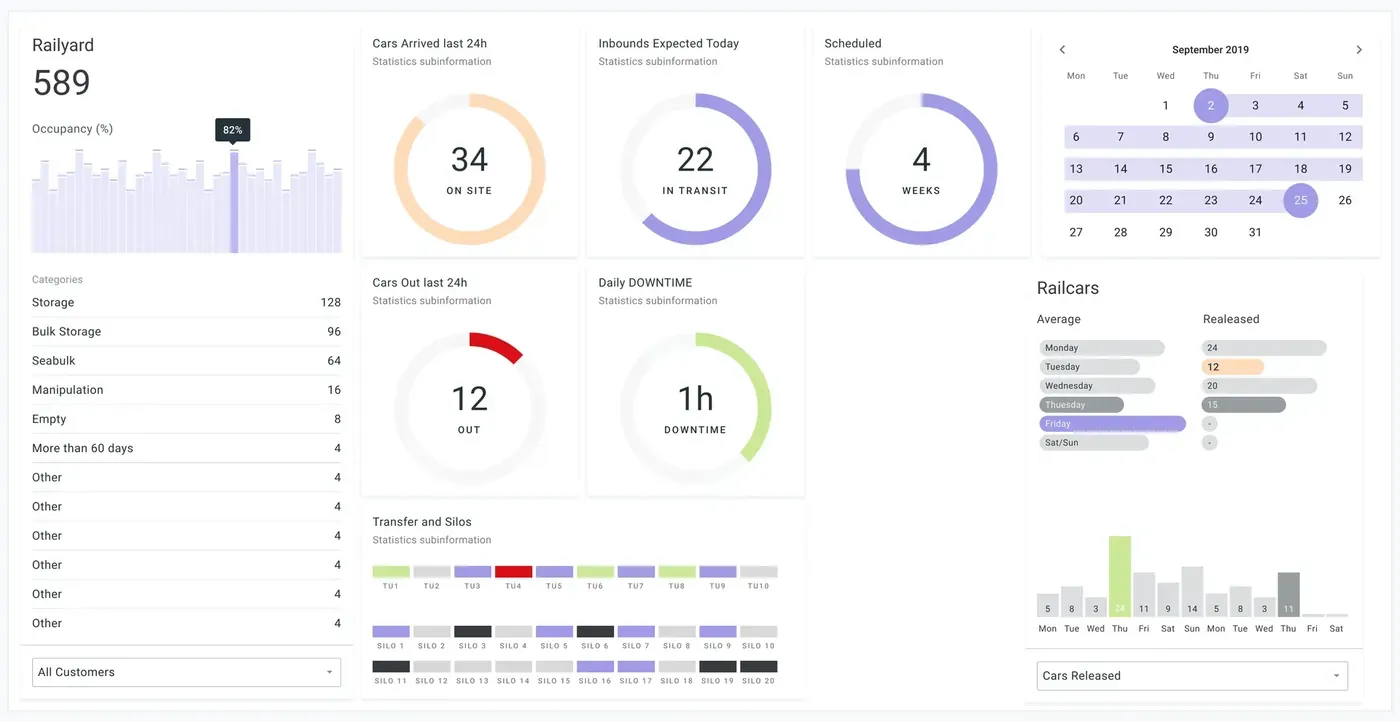
- 1The yard’s occupancy, day by day
- 2Cars on site
- 3Cars expected today
- 4The scheduled range
- 5One tile a unit or silo, coloured by its state
- 6Cars released, by weekday
Plate 1. The plan as a wall display for a zone: what is on site, what is coming, what is scheduled, and which units and silos are busy. The figures are the design’s own.
7Railcar Management
The plan in a hand
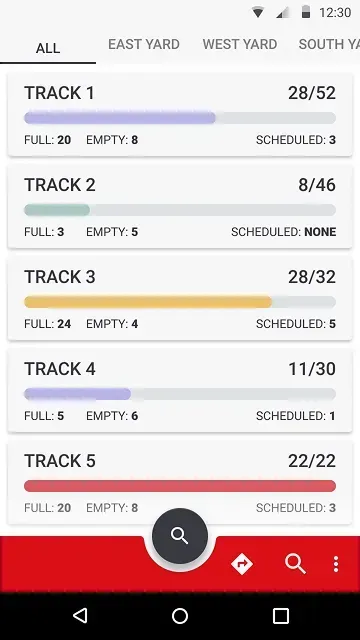
- 1One tab a yard
- 2How full the track is: 28 places of 52
- 3The work the plan holds for it
- 4A full track turns red
Plate 2. The same plan on a phone: a count per track, how full it is, and how much work is scheduled on it. The figures are the design’s own.
8The plan in a hand
The yard and the plan
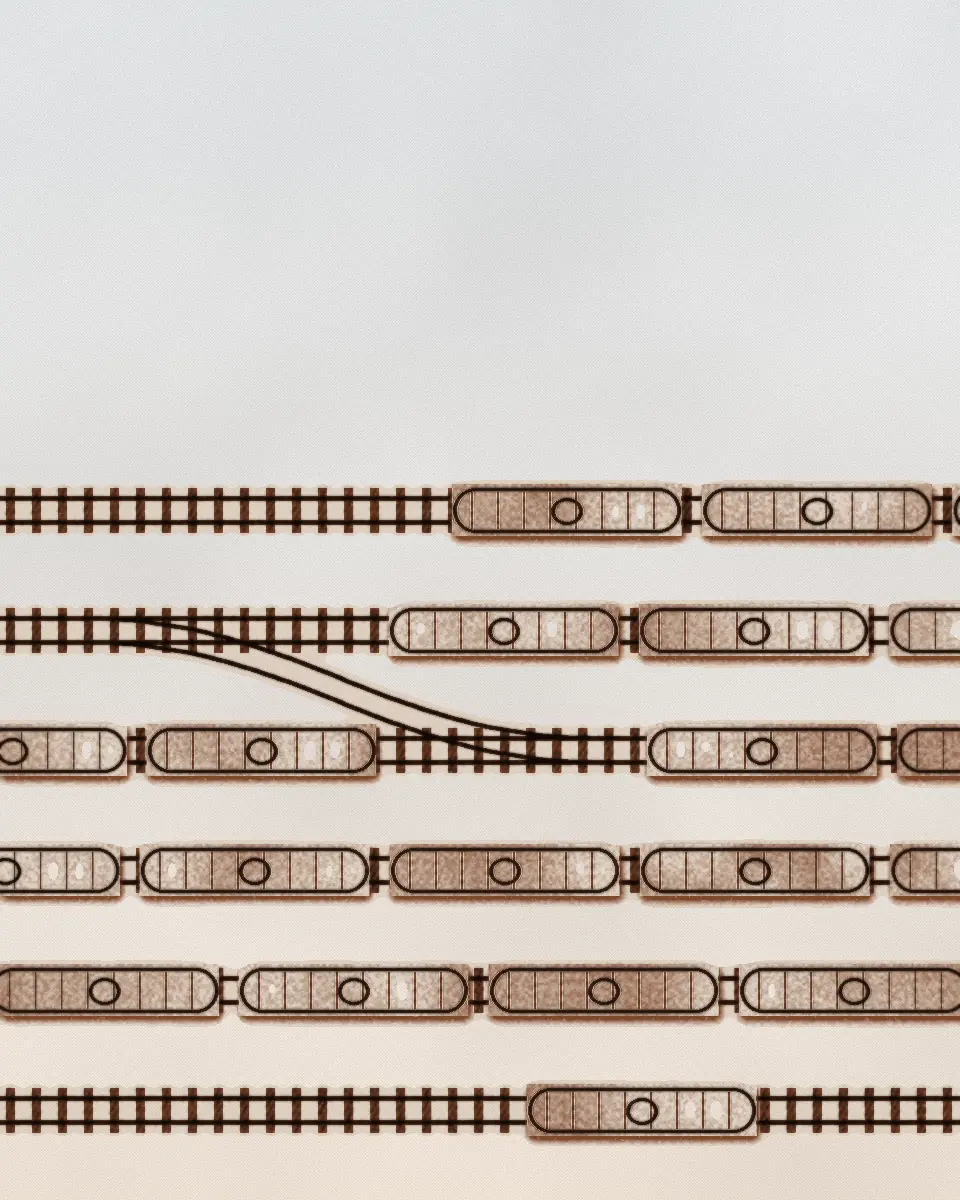
Figure 3. The invented yard of this model, from above: four tracks off one lead, three unloaders, the silos and the cleaning bay. The plan gives each car a place here and a time.
- 1The yard: tracks, unloaders, silos, the cleaning bay.
- 2The plan, which gives each car a place and a time and shows it on the displays.
9Railcar Management
In short
In the model, moving a block recomputes the conflicts, and a printout made earlier shows which of its lines are now out of date.
This model is not the project’s system and uses no data from it.
The rest of the project is in the case study: the rest of the phone app, the safety checks inside the flow, and the pilot with a few operators.
10In short