Uwazi for research and OSINT III
One clock
Uwazi’s Library turned into a research and OSINT tool.
Juan M. Cornejo
Uwazi for research and OSINT III
A notebook
Uwazi’s research tools can put many recordings of one event on one clock and show which ones disagree.
- Notes2
- The sync view, sketched3
- One clock4
- Ten recordings, measured5
- Try it6
- The sync view in the prototype7
- One moment, close up8
- How the clock is read9
- In short10
Uwazi's Library turned into a research and OSINT tool. Every fact says who said it, and a researcher's questions get answered on one screen.
1Uwazi for research and OSINT III
Notes
- When many people film one event, every video starts at its own zero.
- An annotation marks a moment at a given second of a video: the first rocket, 20 seconds into the pier video.
- A moment’s time is the median (the middle value) of what its annotations say, so one wrong note barely moves it.
- An annotation that places a recording on the clock is an anchor. An anchor more than 2 seconds from its moment’s median is an outlier.
- A recording has drifted when its anchors disagree by more than 2 seconds about where it starts. A video made of two joined clips does this.
- A title that names a time is checked against the anchors too. It is flagged if it is more than 2 seconds off.
- A partial annotation, such as “1 sec. in”, is listed but not counted.
2Notes
The sync view, sketched
Figure 1. The sync view, sketched in code. Each recording is a lane. One line through them marks a moment, and a lane more than 2 seconds off is flagged.
3Uwazi for research and OSINT III
Chapter 1
One clock
Researchers mark moments in each video, such as the first rocket. The sync view uses those marks, called anchors, to lay every recording of the event on one wall clock.
No single anchor is trusted alone: a moment’s time is the median, the middle value, of its anchors. The view flags three things: an anchor that is off, a recording that has drifted, and a title that names the wrong time.
4One clock
Ten recordings, measured
| Recording | Anchors | Offset | Drift | Confidence |
|---|---|---|---|---|
| A town’s New Year fireworks (invented) | ||||
| From the pier | 5 | 0 s | 0 s | Three or more anchors, no drift |
| Bridge, east side | 3 | 0 s | 0 s | Three or more anchors, no drift |
| Hotel roof | 3 | 0 s | 0 s | Three or more anchors, no drift |
| Main square | 3 | 0 s | 0 s | Three or more anchors, no drift |
| From a boat | 3 | 0 s | 0 s | Three or more anchors, no drift outlier anchor |
| Hillside, two clips joined | 4 | 0 s | 6 s | Anchors disagree by more than 2 s drifted |
| Balcony | 2 | 0 s | 0 s | One or two anchors title 3 s off |
| Parked car | 2 | 0 s | 0 s | One or two anchors partial annotation |
| Arrived late | 0 | none | none | Title time only |
| Harbour webcam | 0 | none | none | No clock |
Offset is the median distance of a recording’s anchors from their moments’ medians. Drift is how far apart its own anchors put its start. The hillside video is two clips joined, and its drift is 6 seconds. The boat has one anchor 4 seconds from its moment’s median, so it is flagged as an outlier. The balcony’s title says 23:59:58, but its anchors put the start at 23:59:55. The car’s first anchor, “1 sec. in”, is partial, so it is listed and not counted.
Table 1. Ten recordings of one event, measured when the page was built with the prototype’s sync rules, rewritten for this page. The event and every recording are invented.
5Uwazi for research and OSINT III
Try it
Figure 2. The prototype’s sync rules, rewritten for this page, run on an invented event. Drag a lane along the clock, or drag one anchor. Click the clock to see which recordings are running at that second.
6Try it
The sync view in the prototype
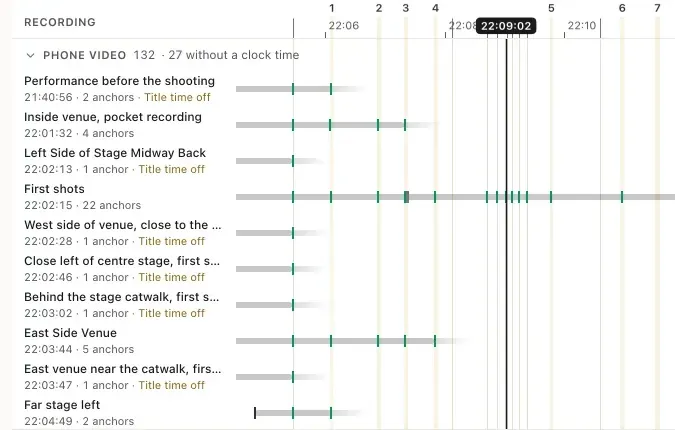
- 1A moment on the ruler, numbered
- 2The playhead, on the wall clock
- 3One recording: its title, its clock time, its anchors
- 4One recording, a lane; each tick an anchor
- 5A moment’s line runs through every lane
- 6The group: how many recordings, how many with no clock time
Plate 1. Recordings of one event as lanes on one wall clock, in the research prototype. Each tick is a moment someone marked, and an amber “Title time off” flags a title whose time disagrees with its marks. The frame holds a real event’s public recordings; this notebook’s own sample is invented.
7Uwazi for research and OSINT III
One moment, close up
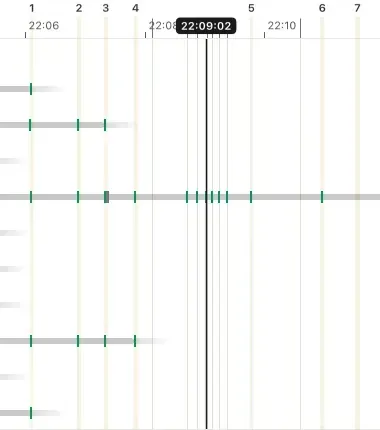
- 1Moment 4 on the ruler
- 2One recording’s anchor on moment 4
- 3Another recording’s anchor, the same moment
- 4Another recording, marked at moments 1, 2 and 3, not 4
- 5The playhead
Plate 2. A detail of the same view. Anchors from different recordings fall on one moment’s line, and that is how each recording is placed on the clock.
8One moment, close up
How the clock is read
Figure 3. One moment on the clock. Each recording’s anchor drops straight down onto the clock, the median of the drops is the moment, and an anchor that lands far from it is flagged.
- 1Each recording is a lane on the clock.
- 2Each moment’s time is the median of its anchors across the lanes.
- 3An anchor more than 2 seconds from the median is flagged as an outlier. A lane whose anchors disagree about its start is flagged as drifted.
9Uwazi for research and OSINT III
In short
A recording is placed on the clock by its anchors, and each moment is their median, so one wrong annotation barely moves the clock. An anchor more than 2 seconds from its moment’s median is flagged, and so is a recording whose anchors disagree by more than 2 seconds, or a title that does.
Two other notebooks cover the rest of the research tools: Uwazi for research and OSINT I, what connects two records, and Uwazi for research and OSINT II, who says so. The sync view is part of a prototype on static data, with no backend, made for Huridocs and not shipped.
10In short